 Anuloma Viloma Timer
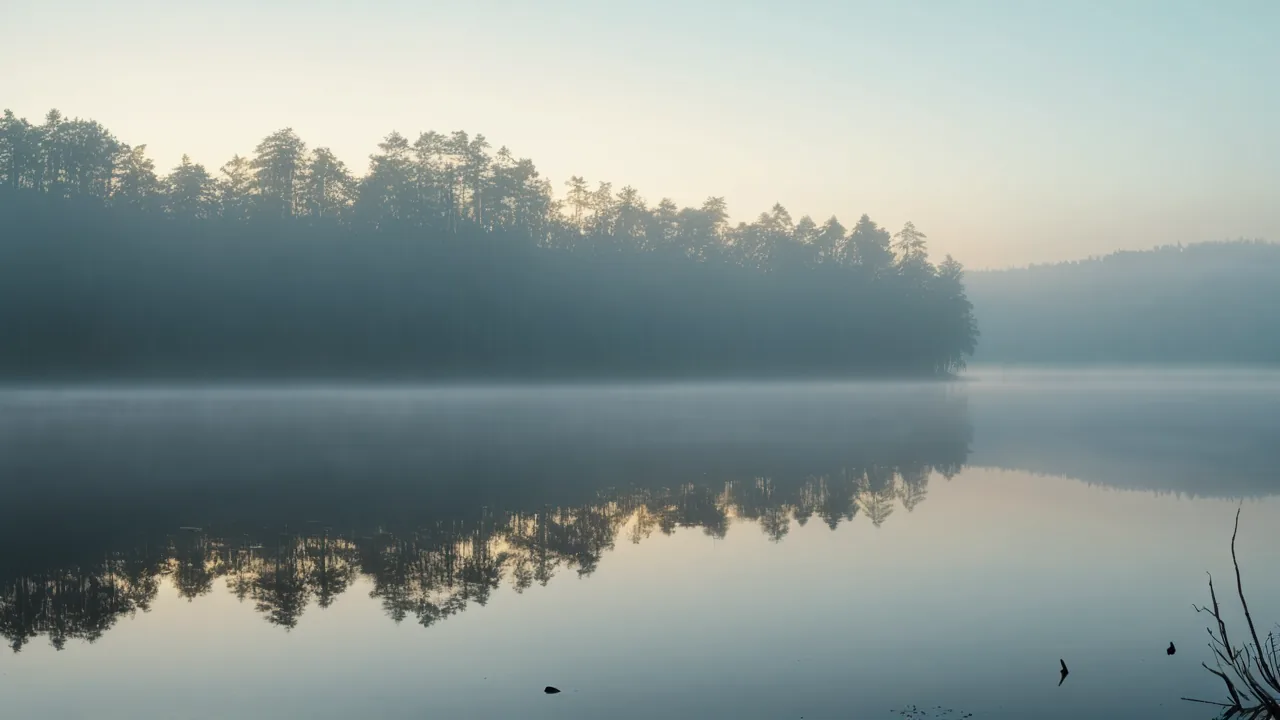
Mind still racing at bedtime? Breathe with us.
That is the line that opens tonight’s short video: two slow rounds of alternate nostril breathing, with a timer on screen. Two rounds take less than a minute. This post is the longer version, a full five-minute session you can do sitting on the edge of your bed, with nothing to buy and nothing to learn first except the count.
Alternate nostril breathing goes by several names. In yoga texts it is nadi shodhana, “channel cleansing”. Across India most people call it anulom vilom. The Hatha Yoga Pradipika, a yoga manual from the 15th century, describes it plainly: draw the breath in through one nostril, let it out through the other, then reverse. The mouth stays closed the whole time. That is the entire technique. Everything else is pace.
Before you start
Sit upright. A chair is fine, as long as your back is tall and both feet are flat on the floor. Cross-legged on a cushion is fine too. Lying down tends to turn the practice into a nap, so save that for after.
Practise on an empty stomach, or at least a couple of hours after a meal. That is the traditional rule, and it also makes the breath easier.
Skip it today if your nose is blocked, if you have a fever, or if you feel unwell. Alternate nostril breathing is gentle, but it depends on air moving freely through each side.
Your hand: rest your right thumb lightly beside the right nostril and your ring finger beside the left. You will close one side at a time with the lightest touch, never a pinch.
The count
This session uses a 1:1 count: the inhale and the exhale are the same length. Start with four seconds each way. If that feels easy after a round or two, move to five, then six. Tonight’s video uses six.
There is no breath hold in this session. Holds (kumbhaka) come later, if at all, and should always be calm, seated and timed, never “as long as you can”.
One round
- Close the right nostril. Breathe in through the left for four.
- Close the left. Open the right. Breathe out through the right for four.
- Breathe in through the right for four.
- Close the right. Open the left. Breathe out through the left for four.
That is one round: in left, out right, in right, out left. At four seconds a side it takes sixteen seconds. At six seconds it takes twenty-four.
The five-minute session
- Minute 0 to 1: two or three ordinary breaths with your hand in your lap. Notice which nostril feels more open. (One usually does. Your nose shifts dominance from side to side over the day, a pattern called the nasal cycle.)
- Minutes 1 to 4: ten rounds at a four count, or eight at a five count. Keep the breath quiet enough that someone beside you would not hear it.
- Minutes 4 to 5: drop the hand. Breathe normally through both nostrils for a minute and notice what has changed, if anything.
If you lose count, finish the round you are on and start again from the left. Nobody is checking.
When to stop
Stop and breathe normally if you feel dizzy, light-headed or short of air. That almost always means the breath has become too forceful, not too slow. Come back with a shorter count and a softer breath. The practice should feel easier as it goes, not harder.
What the evidence can and cannot say
It is tempting to promise a result. The honest version is smaller. A 2026 study from King George’s Medical University in Lucknow (Verma, Narayan and Singh, International Journal of Research in Medical Sciences, September 2026) asked 52 healthy young adults to practise anuloma viloma for ten minutes a day for four weeks, and reported lower pulse and blood pressure and higher peak expiratory flow after the practice phase than after a phase with no breathing practice. It is a small study in healthy 18 to 26 year olds, the published abstract gives no effect sizes, and it does not say whether allocation was randomised. Read it as a reason to try a few weeks of daily practice and pay attention to your own experience, not as a treatment claim.
What the study does reflect is the dose most teachers recommend anyway: a short session, most days, for a few weeks. Five minutes before bed is a realistic place to start. Ten is a good place to grow into.
Why the evening
Nothing in the tradition says alternate nostril breathing has to happen at night. The Hatha Yoga Pradipika actually sets four sittings a day: sunrise, noon, sunset and midnight. Most people start with one, and the end of the day is when a racing mind is most noticeable and a quiet five minutes is easiest to protect. Put the phone face down, sit on the edge of the bed, and count.
Tonight’s video gives you the first two rounds. Save it, and use it as the opening of the five-minute session above.
Sources: Verma S, Narayan J, Singh S, “Effect of anuloma viloma pranayama on cardiorespiratory parameters in apparently healthy young adults”, International Journal of Research in Medical Sciences 14(10), 2026 (https://www.msjonline.org/index.php/ijrms/article/view/17273). Hatha Yoga Pradipika, chapter 2.
Anuloma Viloma Timer is free on the App Store. No subscription necessary.