 Anuloma Viloma Timer
A northern elephant seal naps while holding its breath, spiralling down hundreds of metres into the dark.
That sentence sounds made up. It is not. In 2023, a team led by Jessica Kendall-Bar published a study in Science in which they recorded the brain activity of wild northern elephant seals off the coast of California. What they found changes how you picture a seal at sea. Out on their long foraging trips, the seals sleep for about two hours a day. They do it underwater, in short naps taken during deep dives. Many of those naps happen as the seal drifts downward in a slow, lazy spiral, the researchers’ “sleep spiral”, before it wakes, swims on and eventually rises to breathe.
So the animal is doing two things at once that would end badly for us: holding its breath for a long time, and falling asleep while it does.
Why a seal can do this
Elephant seals are among the great breath-hold divers. Published dive records run to well over an hour, with most dives far shorter. Like other deep-diving mammals, they do not rely on a big lungful of air. Most of the oxygen for a dive is stored in their blood and muscle, and their bodies are built to spend it slowly: the heart slows, blood is directed to the organs that need it most, and they tolerate conditions that would make a person black out.
A second animal, the opposite problem
The seal’s challenge is too little air because it has left the air behind. The bar-headed goose has the opposite problem: it is surrounded by air, but there is not enough oxygen in it.
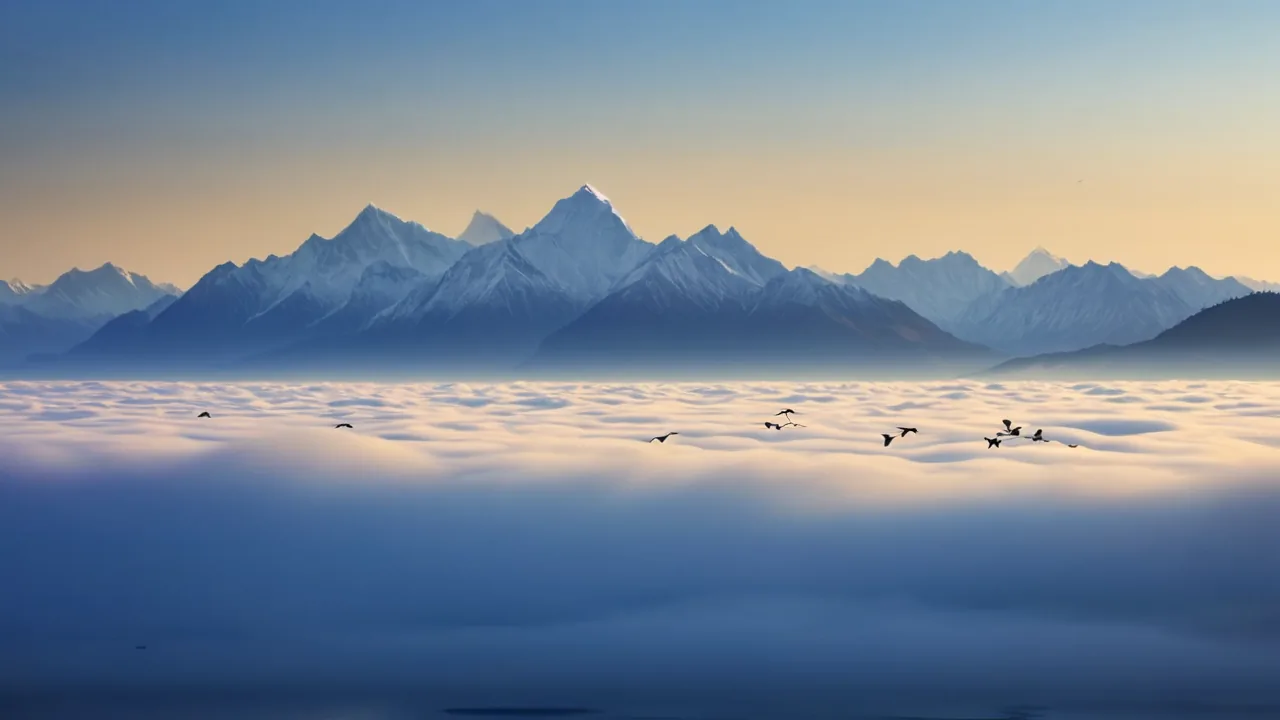
Bar-headed geese migrate between Central Asia and India, and their route crosses the Himalayas. Researchers led by Lucy Hawkes fitted geese with trackers and published their flights in PNAS in 2011 and Science in 2015. The highest altitude they recorded was 7,290 metres. At that height the air pressure, and so the oxygen in every breath, is well under half of what you get at sea level.
How do the geese cope? One part of the answer is in how they breathe. Lab work by Graham Scott and William Milsom in 2007 found that bar-headed geese respond to low oxygen by breathing more deeply, taking bigger breaths, rather than only breathing faster. Their blood also holds on to oxygen unusually well. Depth over speed is a nice detail, because it runs against the instinct most of us have when we feel short of air: to breathe faster and shallower.
These are not targets
It would be easy to turn these animals into a challenge. Hold your breath like a seal. Breathe like a goose at altitude. Please do not. These animals have bodies shaped by millions of years for exactly these conditions. We do not, and pushing a breath hold to the limit, especially in water, is how people get hurt.
What they can be is a reminder that breath is more adjustable than it feels. The seal’s held breath is calm, not strained. The goose’s answer to thin air is a deeper breath, not a frantic one. Both of those are qualities you can practise on a chair at home, with no risk at all.
The version for a person on a chair
Tonight’s video on our channels is a single, seated round of the classic 1:4:2 count from pranayama, the breathing practice of yoga:
- Sit upright, shoulders soft.
- Close the right nostril and breathe in through the left for 8 seconds.
- Hold gently for 32 seconds. This hold has a name in the Hatha Yoga tradition: kumbhaka.
- Breathe out through the right nostril for 16 seconds.
That is it. One round. If 32 seconds feels like a strain, use a shorter count: in for 5, hold for 20, out for 10 keeps the same ratio. The point is a calm hold, not a long one. Stay seated, do not breathe fast beforehand, and stop and breathe normally if you feel dizzy or lightheaded. Never practise breath holds in or near water. If you have a heart or blood pressure condition, or you are pregnant, skip the hold and simply breathe slowly in and out through alternating nostrils.
Notice what happens in the hold. Most people find the first few seconds easy and then feel a small urge to breathe. You do not need to fight it hard. Let the shoulders drop, let the jaw soften, and count. When the exhale comes, let it be slow. That slow exhale, more than the hold, is where many people feel the settling effect of the practice.
Breathing where you shouldn’t
This week we have been looking at animals that breathe in places breath should fail: under ice, in mud, at depth and now in the thin air above the Himalayas. None of them is a model for what a person should attempt. All of them are a good prompt to look at the one breath you are taking right now, and ask whether it could be a little slower and a little deeper.
The elephant seal will be napping somewhere in the dark Pacific tonight. You get to do the easier thing: sit down, breathe in for eight, and hold for a calm thirty-two.
Sources: Kendall-Bar, J. M. et al., “Brain activity of diving seals reveals short sleep cycles at depth”, Science, 2023. Hawkes, L. A. et al., “The trans-Himalayan flights of bar-headed geese”, PNAS, 2011, and “The paradox of extreme high-altitude migration in bar-headed geese”, Science, 2015. Scott, G. R. and Milsom, W. K., “Control of breathing and adaptation to high altitude in the bar-headed goose”, American Journal of Physiology, 2007.
Anuloma Viloma Timer is free on the App Store. No subscription necessary.