 Anuloma Viloma Timer
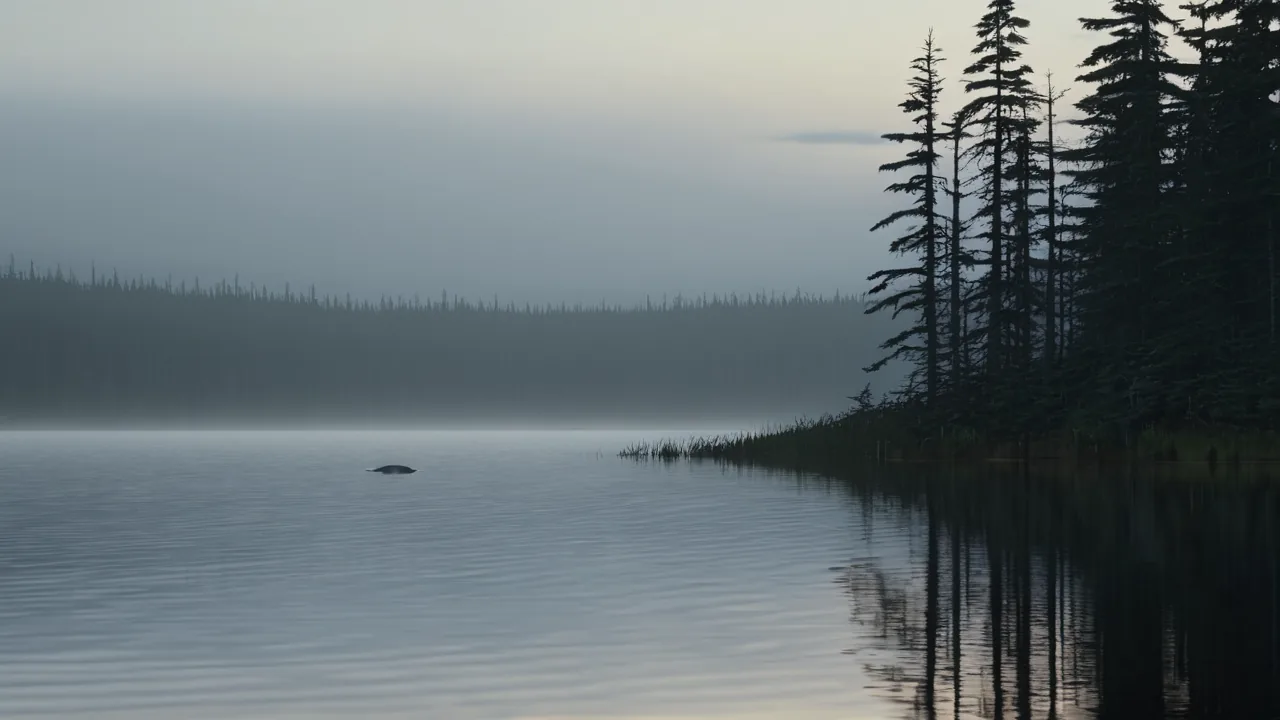
A hooded seal can dive past 1,000 metres on a single breath.
That is not a guess from one lucky sighting. In the 1990s, Norwegian physiologists Lars Folkow and Arnoldus Blix fitted satellite-linked dive recorders to 16 hooded seals in the Greenland and Norwegian Seas and logged roughly 120,000 dives (Folkow and Blix, Polar Biology, 1999). Most of those dives were ordinary working dives for a seal: five to twenty-five minutes, between 100 and 600 metres down. The extremes were something else. Some passed 1,016 metres. Some lasted longer than 52 minutes.
You will see bigger numbers online. Some summaries say 1,500 metres. We could not trace that figure to a primary source, so we are not using it. The tagged numbers are remarkable enough.
How a seal gets away with it
A diving seal is not holding a huge lungful of air. Deep-diving seals often breathe out before they go under. Their oxygen is stored in the blood and muscles instead: a large blood volume, rich in haemoglobin, and muscle loaded with myoglobin, the pigment that makes seal meat so dark. Underwater, the heart slows and blood is steered toward the brain and heart, while less critical tissues make do.
The seal is not toughing it out. It is built so that a long breath-hold is the normal working state of its body.
A moose, of all animals
Today’s second breath-holder lives nowhere near the ocean. Moose dive for water plants in northern lakes, up to about five metres down, according to work by Ohio University anatomist Lawrence Witmer as reported by the University of Alaska Fairbanks and Northern Woodlands. When a moose puts its head under, its nostrils close. The water pressure then presses that seal tighter the deeper the animal goes. Few mammals can close their nostrils with muscle at all.
The seal stores oxygen. The moose shuts the door. Both are solving the same problem: how to stay calm and functional while not breathing.
What this does not mean for you
Here is the part that matters most. Animal records are not targets. You do not share a seal’s blood volume or myoglobin, and you do not have a moose’s self-sealing nose. The human version of the “dive reflex” is real but modest: cold water on the face slows the heart a little. That is about as far as the comparison goes.
So the rules for a human breath-hold are simple and non-negotiable:
- Sit down. Never hold your breath standing, driving, or anywhere a faint could hurt you.
- Never in or near water. Shallow-water blackout gives no warning.
- Never breathe fast first. Hyperventilating before a hold makes it feel easier while making it more dangerous.
- Never “as long as you can.” Pick a short, timed hold and stop there.
- Stop at any lightheadedness.
The hold that is worth practising
Classical pranayama has its own breath-hold, called kumbhaka, and it was never about records. In the traditional 1:4:2 count, you breathe in for a count, hold for four times that count, and breathe out for twice the count. Start with an inhale of five seconds and the hold is twenty seconds, the exhale ten. That is a calm hold, not a contest.
Paired with alternate nostril breathing (nadi shodhana, or anulom vilom), it goes like this: breathe in through the left nostril, hold gently, breathe out through the right. Then in through the right, hold, out through the left. The exhale is long and unhurried. If twenty seconds feels like a strain, shorten the count. The point is that the hold stays easy.
Is there evidence for slow, structured breathing like this? Some, with honest limits. A 2022 paper in the Journal of Clinical Medicine describes slow-paced breathing with heart rate variability feedback as a non-invasive way people can influence their own vagal activity (https://pmc.ncbi.nlm.nih.gov/articles/PMC9571900). A 2025 meta-analysis of pranayama trials for mental health in Frontiers in Psychiatry found short-term benefit as an add-on, while warning of high risk of bias and saying it should not replace standard care (https://www.ncbi.nlm.nih.gov/pmc/articles/PMC12392162/). That is a reasonable place to stand: a useful daily practice, not a cure.
The real lesson from the seal
What the hooded seal shows is not that holding your breath for longer is better. It shows that a breath-hold goes well when the body is calm, the conditions are right, and nothing is forced. A seal at 600 metres is not panicking. It is doing what its body was built for.
For us, the equivalent is modest and repeatable: a seated twenty-second hold, a slow exhale, five quiet minutes, done every day.
Anuloma Viloma Timer is free on the App Store. No subscription necessary.